Blog

  • Xenoblade Chronicles 3

    Xenoblade Chronicles 3 begins with a war that has become a way of life. Its soldiers are born to fight, given only ten years to live and taught to see the opposing nation as an enemy. For six of those soldiers, an encounter on the battlefield turns that certainty into a much larger question: who benefits from a world built around endless conflict?

    Released for Nintendo Switch in 2022, Monolith Soft’s role-playing game combines that premise with expansive regions to explore and a combat system built around a large, flexible party. It is the third numbered entry in the Xenoblade Chronicles series, but it also works as an introduction to the series’ particular blend of science fiction, fantasy and character-driven storytelling.

    A world shaped by a war without an end

    The game takes place in Aionios, a world divided between the nations of Keves and Agnus. Their soldiers fight in colonies and have lifespans measured in ten “terms,” with each term lasting a year. Those who survive to the end of their tenth term can take part in a ceremony known as a Homecoming. Many never get that far.

    That limited lifespan gives the conflict a different character from a conventional war between rival kingdoms. The soldiers have little time to imagine an existence beyond combat, while the colonies depend on the life energy taken from fallen enemies. The setting makes the war feel like an entire social order, rather than simply a backdrop for the heroes’ adventure.

    The central party brings together three soldiers from each side. Noah, Lanz and Eunie belong to Keves; Mio, Sena and Taion come from Agnus. Circumstances force them to cooperate, and their journey takes them away from the roles their respective nations assigned them. Their shared goal is to reach a place called Swordmarch, but the route there involves confronting the institutions and assumptions that have defined their lives.

    Noah and Mio are also off-seers, soldiers who play flutes to send off the dead. It is a small but important detail: even in a society organized around fighting, the two characters have a duty to acknowledge what that fighting costs. Their shared role provides a point of connection before the former enemies have much reason to trust one another.

    Real-time combat with a full party

    Combat in Xenoblade Chronicles 3 takes place in real time. Characters automatically attack when positioned near an enemy, while the player chooses when to use stronger abilities called arts. Rather than relying on precise button inputs for every swing, the system asks players to consider positioning, timing and how each party member contributes.

    Arts have different effects and recharge after use. Some are more effective from a particular position, for example, giving players a reason to move around an opponent rather than simply stand in front of it. Effects such as Break, Topple, Launch and Smash can also be combined into sequences, rewarding a party whose abilities complement one another.

    Kevesi and Agnian classes approach arts differently: Kevesi arts recharge over time, while Agnian arts recharge through auto-attacks. That distinction matters when building a character, particularly once players begin combining abilities from different classes. It adds another consideration to the rhythm of a fight: an art’s power is only part of its value if its recharge method does not suit the situation.

    All six main characters participate in battle, and a seventh party slot can be filled by a Hero recruited during the journey. Players can switch between the six protagonists during combat, making it possible to take direct control of a healer, defender or attacker as circumstances change. The Hero fights alongside them but is not directly controlled.

    Managing such a large group can initially be more demanding than following a single action-game character. The benefit is that encounters can accommodate several jobs at once: defenders draw enemy attention, healers keep allies fighting and attackers focus on damage. Success depends not just on the character under direct control, but on how the whole party is assembled.

    Classes make the six heroes adaptable

    Each protagonist begins with a class suited to one of the three broad combat roles: attacker, defender or healer. As the story progresses and the party meets Heroes, additional classes become available. The protagonists can then change classes, allowing a character who began as an attacker to take on a defensive or support role instead.

    The system gives players room to alter their approach without changing the main cast. A difficult encounter might encourage a more defensive arrangement, while a different party setup can put greater emphasis on damage or healing. Each class also has its own arts and skills, so a role describes a general purpose rather than a complete picture of how a character plays.

    Learning classes has longer-term value, too. Characters can equip certain mastered arts and skills from other classes, bringing elements of an earlier build into a new one. Fusion Arts take that mixing further by allowing compatible arts to be used together. The result is a progression system concerned with what characters have learned across multiple roles, not just their current class rank.

    There is a trade-off in that flexibility. With six controllable characters and a growing selection of classes, equipment and abilities, party management can require attention between major encounters. Players who enjoy experimenting with RPG builds have a great deal to work with; those who prefer a fixed set of straightforward roles may find the options take time to sort through.

    Ouroboros and the importance of pairs

    The six protagonists’ connection is expressed in combat through Ouroboros. Each Kevesi character is paired with an Agnian character, and the two can interlink to become a powerful shared form. Noah pairs with Mio, Eunie with Taion, and Lanz with Sena.

    Interlinking gives the party access to a different set of abilities, but it is not a permanent transformation. Heat builds while an Ouroboros form is active, eventually bringing it to an end if it is not cancelled first. Players therefore have to consider when the change will be useful, rather than treating it as a replacement for the regular party.

    The mechanic also ties the story’s central idea to its battles. The soldiers begin on opposing sides of a conflict that defines their identities, yet their strongest shared ability depends on cooperation across that divide. Each pair has to function as a unit, making the relationships within the group relevant to more than dialogue scenes.

    Chain Attacks offer another way to coordinate the party. Once the relevant gauge is filled, players can initiate a sequence that pauses the flow of ordinary combat and lets them select characters and arts in a more deliberate order. These sequences can turn the group’s combined strengths into a substantial burst of damage, while giving players another system to consider when planning around a tougher opponent.

    Exploration beyond the main route

    Aionios is made up of large areas containing landmarks, monsters, resources and colonies. The journey moves through different regions rather than presenting the entire setting as one uninterrupted open world. Exploration can lead to optional fights and side stories, as well as useful places to return to through fast travel.

    Colonies are especially important because they show what life in Aionios looks like beyond the six protagonists. Characters encountered there have their own relationships and concerns, and optional quests can develop those stories. The game’s affinity chart tracks connections between people the party meets, making it easier to see how individual communities fit together.

    Hero quests are a particularly significant form of optional content. They introduce characters who can join the group as the seventh combatant and make new classes available to the protagonists. That gives these stories a practical consequence as well as a narrative one: learning about another person’s place in Aionios can also expand the party’s tactical options.

    Rest spots provide a quieter counterpoint to exploration and battle. Here, the group can discuss information they have gathered, prepare meals and craft gems that improve character builds. These activities connect the journey’s smaller discoveries to progression without making every useful reward come from defeating an enemy.

    Storytelling and presentation

    The scale of Aionios is central to the game’s presentation. Vast landscapes and the remains of enormous figures create a world that often dwarfs its travelers. Those sights also give exploration a narrative purpose: the environment suggests a history that the party does not initially understand, encouraging questions about how the world came to be.

    Against that scale, the story stays closely focused on its six leads. Their different personalities and military backgrounds shape the group’s conversations, while their limited lifespans give urgency to decisions that might otherwise feel abstract. The game is interested in the possibility of choosing a life, not just in discovering how to stop a war.

    That focus is worth keeping in mind for players approaching it as an RPG. There is a substantial amount of combat and customization, but the characters and their circumstances are not merely a frame for those systems. Cutscenes and conversations carry much of the experience, and the story’s themes are closely connected to the colonies and people encountered along the way.

    Where it fits in the series

    Xenoblade Chronicles 3 is a single-player game and the third numbered main entry in the series. It has connections to Xenoblade Chronicles and Xenoblade Chronicles 2, including elements of its world that will be meaningful to returning players. Its central cast and immediate conflict, however, provide a starting point for newcomers rather than requiring them to begin as members of an established party.

    Players interested in those wider connections can also look to Future Redeemed, a separate story included in the game’s Expansion Pass. It brings together characters and ideas from across the numbered games. Because it engages more directly with the series’ broader history, newcomers may prefer to leave it until they have spent time with the main game and its predecessors.

    What kind of RPG to expect

    Xenoblade Chronicles 3 is suited to players interested in a story-led adventure with room to customize a large party. Its distinctive appeal lies in how its pieces support one another: classes encourage characters to take on unfamiliar roles, Ouroboros pairs former enemies together, and side stories reveal communities living under the same system the protagonists are trying to understand.

    It is also an RPG with a lot to manage. The real-time battles, class combinations and seven-character party offer tactical possibilities, but they ask for more attention than a game centered on controlling one fighter. For readers looking for a substantial single-player journey where combat systems and character relationships share the spotlight, that combination is the clearest reason to take an interest in Aionios.
  • Baldur’s Gate 3

    Baldur’s Gate 3 begins with a problem that is both immediate and difficult to ignore: a mind flayer parasite has been placed inside your character’s head. Removing it becomes an urgent goal, but the journey quickly expands into a story about alliances, power and the consequences of choosing whom to trust.

    Developed and published by Larian Studios, the role-playing game draws on Dungeons & Dragons and its Forgotten Realms setting. It combines turn-based combat, character-driven storytelling and exploration with a defining idea: a challenge does not always have one obvious solution. The same encounter might invite a fight, a conversation or an attempt to find another way around.

    Released in 2023, Baldur’s Gate 3 is the third mainline game in the series, but it does not require a detailed knowledge of the earlier titles. For newcomers, it is an expansive fantasy RPG with its own central story. For players familiar with tabletop role-playing, it offers a digital interpretation of the choices and uncertainty that make those games distinctive.

    A familiar fantasy world with an unfamiliar problem

    The game takes place in the Forgotten Realms, a setting filled with cities, wilderness, magic and creatures associated with Dungeons & Dragons. The city of Baldur’s Gate gives the series its name, although the adventure encompasses considerably more than its streets.

    The central threat is the parasite, often referred to as a tadpole, implanted by mind flayers. The prospect of transforming into one of these creatures gives the opening a clear sense of urgency. It also creates a shared problem for the people the protagonist meets: several potential companions have their own connection to the predicament and their own reasons for seeking answers.

    That setup gives the story room to move beyond a simple search for a cure. Players encounter factions with competing interests, people affected by conflicts they did not create and opportunities to make use of the powers associated with the parasite. The question is not just how to survive, but what compromises a character is willing to make along the way.

    Building a character, and a perspective

    At the beginning of the game, players can create a custom character by choosing options including their race, class and background. Those decisions affect more than appearance. A class determines the abilities a character brings to combat and exploration, while other choices can provide different ways to engage with the world and its people.

    A fighter and a wizard, for example, approach danger with different tools. A character skilled in persuasion may be better equipped to negotiate, while another might rely on stealth or physical force. None of these choices guarantees that every situation will be easy. Instead, they shape which opportunities are most accessible and which weaknesses the rest of the party may need to cover.

    There is also the option to play as an Origin character: a predefined protagonist with an established identity and personal story. Several Origin characters can instead be recruited as companions when playing someone else. The Dark Urge is another Origin option, built around a customisable character with a particular narrative premise.

    This distinction matters because Baldur’s Gate 3 is interested in role-playing as well as character statistics. Creating a protagonist is not merely a matter of choosing the strongest abilities; it is also a way to decide whose perspective will frame the story.

    Companions are more than combat roles

    The people who can join the party bring their own histories, beliefs and priorities. Among them are Shadowheart, a cleric with secrets of her own; Lae’zel, a githyanki warrior; and Astarion, a vampire spawn. Other potential companions include the wizard Gale, the warlock Wyll and the barbarian Karlach.

    Each offers something useful mechanically, but their importance extends beyond the skills they contribute in a fight. Conversations and events can reveal more about their circumstances, while the player’s decisions can affect how companions respond to the protagonist. Some relationships can also become romantic.

    The result is a party that can feel like a group of individuals rather than a set of interchangeable character classes. Their interests do not always align neatly with one another, and helping one person may require a player to consider what that choice means for someone else.

    Not every companion has to remain in the group, and not every relationship will develop in the same way. That gives social decisions weight without reducing them to a simple search for the answer everyone likes.

    Choices, dice and consequences

    Much of the game’s role-playing takes place in dialogue. Players choose what their character says, but conversations are not solely about selecting a preferred personality. They can determine whether a confrontation escalates, whether information becomes available or whether another character is willing to cooperate.

    Many important attempts are resolved through dice rolls, drawing directly from the tabletop rules. A persuasion check, for instance, tests whether a character can convince someone, while other checks might reflect deception, intimidation or knowledge. Character abilities and proficiency can improve the odds, and circumstances can sometimes make a roll more or less favourable.

    The visible dice are an important part of the experience. They make uncertainty explicit: having a plan and having a good chance of success are not the same as being guaranteed the outcome. A failed roll can change the direction of a conversation rather than simply presenting a conventional game-over screen.

    That does not mean every line of dialogue reshapes the entire story. Some choices have immediate, local effects; others can reach further. The distinction is useful for understanding the game’s appeal: it encourages players to pay attention to the situation and accept that an imperfect result may become part of their version of events.

    Turn-based combat rewards preparation and positioning

    When a disagreement does become a battle, Baldur’s Gate 3 uses turn-based combat. Characters act in an initiative order, moving and using their available actions while enemies do the same. Attacks, spells, special abilities and items all compete for the resources available during a turn.

    The system has a different rhythm from a real-time action RPG. Players have time to consider where their party members stand, which opponent presents the greatest threat and whether an ability is worth using now or saving for later. A character’s position can be as important as the damage listed on a weapon or spell.

    The environment also matters. Height, obstacles and the placement of combatants can affect how an encounter unfolds. Shoving an enemy, moving to a safer position or finding a way around a threat may be more useful than simply attacking the nearest target. Spells and abilities can create opportunities for other party members, making coordination central to effective play.

    For players new to Dungeons & Dragons, the terminology can take some getting used to. Actions, bonus actions, spell slots and concentration all place limits on what a character can do. Those limits are also what make decisions meaningful: a powerful spell may solve a problem now, but using it can leave fewer resources for whatever comes next.

    Exploration is about noticing possibilities

    Outside combat, players explore locations, speak with their inhabitants, investigate points of interest and decide how to approach obstacles. The game is structured around substantial areas to explore rather than one continuous open world, with the main story taking the party through different regions.

    Exploration often connects directly to the party’s abilities. A locked door might invite an attempt to pick the lock, a search for a key or a look for another route. A conversation can reveal information that changes how a location is understood. Different spells and skills can open up possibilities that another party composition might not have readily available.

    This flexibility does not mean that every obstacle has a bespoke solution for every character. Rather, the game gives players a range of tools and situations in which those tools may prove useful. Experimentation is part of the appeal, but it also requires accepting that a plan can fail or produce an unintended consequence.

    Rest is another part of the rhythm. Characters recover resources through resting, and the camp serves as a place to spend time with companions. It is worth paying attention to the circumstances of a situation, however, rather than assuming every problem in the world will wait indefinitely while the party prepares.

    Progression changes what the party can do

    As characters gain experience and levels, they acquire abilities and improve within their chosen classes. The exact options depend on the character, but progression can include new spells, class features and opportunities to specialise. Players can also multiclass, combining levels from different classes.

    Equipment adds another layer to character development. Weapons, armour and magical items can strengthen a character’s existing role or provide another useful option. Deciding who should carry a particular item is therefore part of building a party, not just a matter of comparing individual numbers.

    There is depth here for players who enjoy planning combinations, but the choices can also be demanding. A party has several characters to manage, each with their own abilities and equipment. Those who prefer a straightforward action game may find the number of decisions more involved than expected.

    Sharing the adventure

    Baldur’s Gate 3 supports cooperative multiplayer for up to four players, allowing a group to take on the campaign together. That changes the social dynamic: instead of one person directing every decision, players can bring different characters and priorities to the same adventure.

    Cooperative play can be especially appealing to people who enjoy the collaborative side of tabletop RPGs. One player might focus on conversation while another considers how to approach a dangerous encounter. At the same time, a group must live with the choices its members make. Sharing the story can make an unexpected outcome more memorable, but it also means giving up some control over how events unfold.

    Where it fits in the series and the genre

    The original Baldur’s Gate games were developed by BioWare, while Larian brought its own approach to the third mainline entry. The connection to Dungeons & Dragons remains central, but the turn-based combat and emphasis on interacting with the environment also sit alongside ideas familiar from Larian’s Divinity: Original Sin games.

    That heritage helps explain why the game can appeal to different audiences. Its cinematic conversations and companion stories provide an accessible way into the setting, while its rules, party building and tactical encounters offer more to consider for players who enjoy detailed RPG systems. It is available on PC, Mac, PlayStation 5 and Xbox Series X|S.

    The trade-off is that its freedom comes with complexity. Combat can require careful reading and planning, and a dice roll may frustrate a player who wants complete control over an outcome. Its story is also designed to respond to decisions, which means a single playthrough will not show every possible interaction.

    What makes Baldur’s Gate 3 distinctive is how closely those parts fit together. Character creation affects the tools available; those tools shape encounters; and encounters can alter relationships and the direction of the story. It is a fantasy adventure for players who want to think about not only what their party can do, but also what kind of people they want that party to be.

  • The Legend of Zelda: Tears of the Kingdom

    The Legend of Zelda: Tears of the Kingdom starts with a familiar Hyrule and asks players to look at it differently. The sequel to Breath of the Wild retains the sweeping landscape and open-ended exploration of its predecessor, but adds islands above the clouds, an underground realm and a set of abilities built around manipulating objects.

    Developed and published by Nintendo, the single-player action-adventure was released for Nintendo Switch on 12 May 2023. Its defining idea is not simply that there is more territory to explore. It is that Link has more ways to interact with the world: he can assemble vehicles, combine weapons with materials and send objects back along their previous paths. These systems give players tools to solve problems, while leaving considerable room to decide how to use them.

    A changed Hyrule, above and below

    Tears of the Kingdom takes place after Breath of the Wild, with Link and Princess Zelda investigating a disturbance beneath Hyrule Castle. The opening events separate them and set Link on a journey to understand what has happened to Zelda and confront a renewed threat to the kingdom.

    Much of the surface map will be recognisable to players of the earlier game, from its broad regions to its towns and landmarks. That familiarity has a purpose: returning players have a frame of reference for noticing what has changed, while newcomers still have a vast world to discover. Caves and wells add places to investigate within the landscape, and upheaval has altered parts of Hyrule itself.

    The sequel also extends the world vertically. Sky islands range from small outcrops to larger areas with their own puzzles and routes. Beneath the surface, the Depths form a sprawling, dark environment accessed through chasms. Moving between these layers changes the rhythm of exploration: a trip across the surface might begin with a dive from the sky or lead to an unexpected descent underground.

    Building is part of the adventure

    The most conspicuous addition is Ultrahand, an ability that lets Link pick up, move, rotate and attach many objects. A few logs can become a bridge or a raft. Add wheels or other components and the same basic idea can become a vehicle. The system is useful in obvious ways, but its importance is broader: objects in the environment are not just scenery or resources to collect. They can become parts of a solution.

    Zonai devices expand those possibilities. Fans can provide propulsion, wheels can move a structure across the ground, and other devices have their own uses. Many draw on Link’s energy supply while active, so building something is only part of the challenge; keeping it powered also matters. Players can increase their energy capacity over the course of the adventure.

    Ultrahand does not require every problem to be solved with an elaborate machine. A carefully placed plank can be more useful than a complicated construction, and a vehicle that works on flat ground may not be the right answer for a steep climb. That flexibility is a distinction: the game provides components and rules, but players often choose the scale and complexity of the solution.

    There is a practical trade-off, too. Assembling and positioning objects takes more attention than simply selecting a fixed tool from a menu. For players who enjoy experimenting, that is part of the appeal; those more interested in moving quickly through a story may find themselves spending time managing parts and power. Many obstacles nevertheless offer more than one way forward.

    Abilities that work together

    Ultrahand is only one of Link’s new abilities. Fuse attaches materials or objects to weapons and shields, changing their properties. A monster part can strengthen a weapon, for example, while attaching an object to a shield can give it a different practical use. Weapons can still break, so gathering equipment and deciding what to combine remain part of the adventure.

    Recall sends an object back along the path it previously travelled. A fallen object can become a means of reaching a higher place if Link stands on it and reverses its movement. It can also be used in puzzles and combat, depending on what is moving nearby. Ascend, meanwhile, allows Link to travel upward through a suitable ceiling and emerge on top, offering an alternative to climbing around an obstacle.

    These abilities are most interesting as a set. Ultrahand changes an object’s position; Recall can reverse movement; Ascend changes how Link navigates structures. Rather than giving players a single answer to every obstacle, the game often makes it possible to approach the same space from different directions. The result is a style of exploration in which noticing the environment can matter as much as finding a marked destination.

    Link can also obtain Autobuild, an ability that helps recreate previous Ultrahand constructions. It gives building a longer-term dimension: a useful design can become something to return to rather than a one-off experiment. Materials and resources still matter, so it does not eliminate the need to consider what a construction costs.

    Shrines, combat and progression

    As in Breath of the Wild, exploration supports Link’s progression. Shrines offer concentrated challenges, often involving puzzles or combat. Completing them earns a Light of Blessing; four can be exchanged for an increase to Link’s health or stamina. The choice gives players a straightforward way to shape their priorities, whether they want more room for mistakes in battle or more capacity for climbing and other demanding movement.

    Combat combines familiar Zelda action with the sequel’s flexible systems. Link can use melee weapons, bows and shields, while materials attached through Fuse create additional options. Arrows can also be combined with certain materials, allowing a shot to do more than deal ordinary damage. Because equipment wears out, players have reason to pay attention to what they find rather than rely on one weapon indefinitely.

    Cooking remains a useful form of preparation. Ingredients gathered around Hyrule can be made into meals that restore health or provide temporary benefits. Clothing and armour also help Link deal with different circumstances. Together, these systems encourage preparation without turning the adventure into a conventional character-building RPG: progress is expressed through resources, equipment, health, stamina and the player’s growing understanding of the available tools.

    There is a learning curve in that freedom. The game offers many materials and possible combinations, but not every experiment will be useful in every situation. Players who prefer a clearly prescribed solution may need to adjust to a design that frequently invites them to improvise.

    The Depths and the cost of going further

    The Depths provide a contrast to the surface. Much of the underground world begins in darkness, making visibility an immediate concern. Brightbloom seeds can illuminate areas, while activating Lightroots reveals portions of the map and lights their surroundings.

    The region also introduces gloom as a persistent hazard. Gloom can reduce the hearts Link is able to use, making prolonged expeditions more dangerous if players are unprepared. Returning to the surface or reaching a Lightroot can restore those affected hearts, and certain meals can help as well.

    The Depths are not simply a darker copy of Hyrule. Their limited visibility changes what exploration asks of the player: instead of surveying a distant landmark and choosing a path, there may be a need to create light first and work outward from a safer point. The underground also contains resources useful for upgrading Link’s energy capacity, giving players a reason to return beyond the appeal of uncovering the map.

    A story spread across the kingdom

    The central mystery follows Zelda’s disappearance and the return of a threat associated with Ganondorf. As Link searches for answers, he encounters the people of Hyrule dealing with upheaval in their own regions. The story brings recurring Zelda themes—courage, responsibility and the struggle to protect the kingdom—into a structure that allows players to pursue major objectives in a flexible order.

    Regional storylines lead Link to work with allies connected to Hyrule’s different peoples. Completing these adventures can grant abilities associated with those allies, adding options for traversal or combat. They also give the wider crisis a more local perspective: the threat is not only a distant event at the castle, but something affecting communities across the map.

    Story discoveries are distributed through the world rather than confined to a single path. That suits an adventure built around exploration, although the order in which players encounter information can shape how the mystery unfolds for them. Players eager to follow the main plot can focus on its objectives; those who prefer to wander may spend substantial time on shrines, side activities and discoveries between major story moments.

    What sets it apart from its predecessor

    Tears of the Kingdom shares much of its foundation with Breath of the Wild: climbing, gliding, cooking, equipment that breaks and a world designed for exploration. Its identity comes from changing what players can do within that foundation.

    The earlier game already encouraged players to observe and use their surroundings. The sequel makes physical construction a central part of that approach. A gap is no longer only a question of whether Link can jump or glide across it; nearby materials might allow a bridge, a flying contraption or another solution. Similarly, vertical travel is no longer limited to finding a climbable route when Ascend, Recall and sky islands can all change the possibilities.

    Reusing Hyrule is also a meaningful design choice. It gives the sequel continuity with the earlier adventure, but it may feel different depending on the player. Someone returning to familiar regions can look for changes and new routes; someone hoping for an entirely unrelated setting will encounter a landscape with substantial shared geography. The sky and the Depths broaden that geography rather than replacing it.

    Who is it for?

    Players who enjoy open-ended exploration have plenty to pursue beyond the main story, including shrines, caves, side adventures and the search for useful materials. The building tools add a particular appeal for players who like experimenting with systems and finding their own solutions. Zelda fans also have a direct continuation of Breath of the Wild to explore, with familiar locations and characters alongside new mysteries.

    Newcomers can follow Link’s current adventure without having played the earlier game, though familiarity with Breath of the Wild adds context to returning characters and places. The sequel’s many interlocking systems can be demanding at first, particularly for anyone less interested in inventory management, equipment durability or experimenting with constructions.

    At its core, Tears of the Kingdom is an adventure about possibilities within a defined world. Its story provides a reason to travel across Hyrule, but its most distinctive feature is the freedom to decide how to make that journey—from a simple climb to a machine assembled from whatever happens to be nearby.

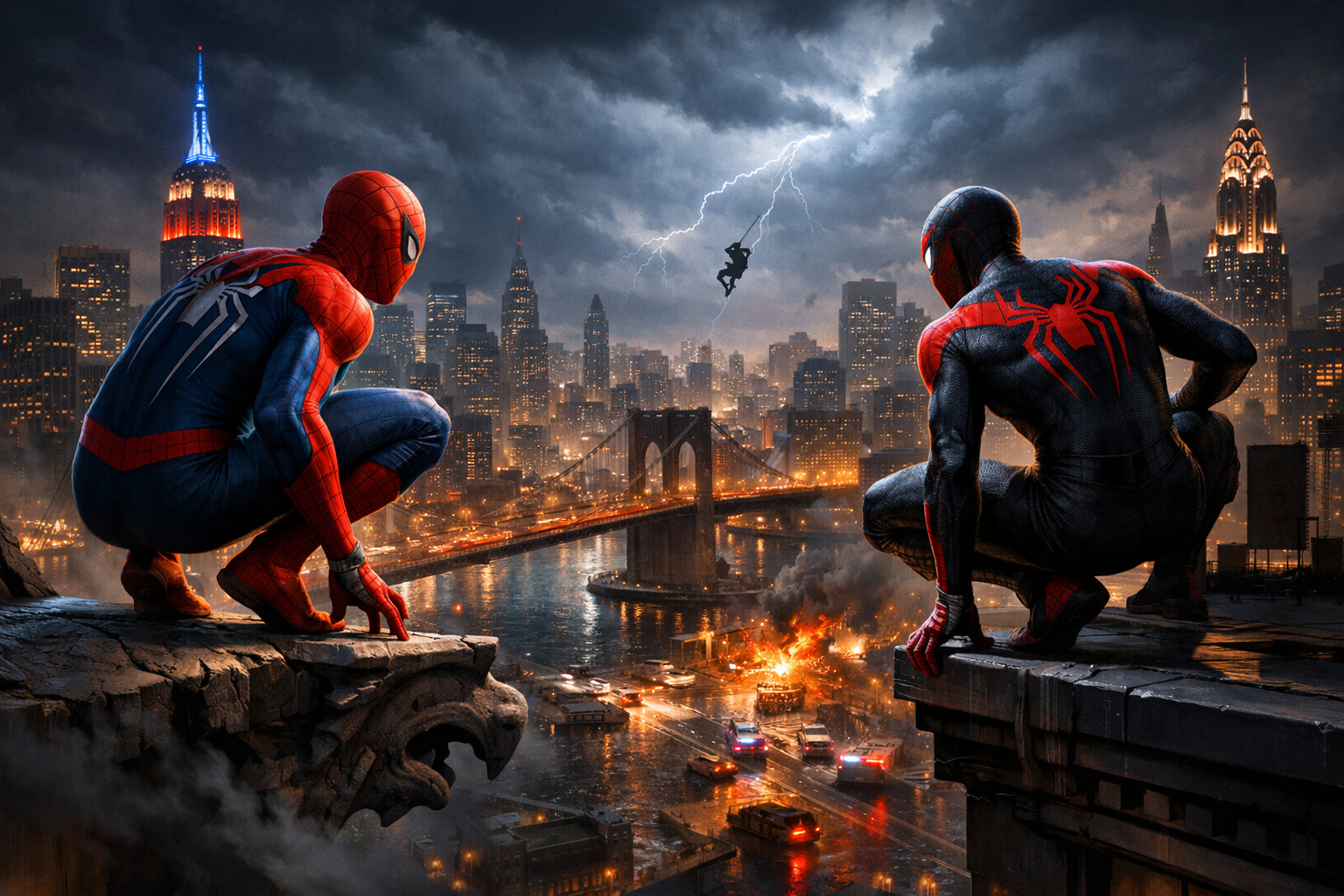
  • Marvel’s Spider-Man 2

    Marvel’s Spider-Man 2

    Marvel’s Spider-Man 2 brings two generations of Spider-Man into the same open-world adventure, giving Peter Parker and Miles Morales a shared city to protect and separate challenges to face. Developed by Insomniac Games, the sequel builds on the studio’s earlier Spider-Man titles with an expanded New York, faster traversal options and a story that puts both heroes under pressure.

    Released for PlayStation 5 in October 2023 and later brought to PC in January 2025, the game is a single-player action adventure rather than a cooperative one. Players can control both Spider-Men, but the experience is structured around a campaign and activities designed for one person. Its distinctive premise lies in how it combines two playable heroes with a familiar superhero fantasy: moving through the city, responding to trouble and trying to balance extraordinary responsibilities with ordinary lives.

    Two Spider-Men, one New York

    Marvel’s Spider-Man 2 follows Marvel’s Spider-Man from 2018 and Marvel’s Spider-Man: Miles Morales from 2020. Those games established Insomniac’s versions of Peter and Miles, along with a New York populated by familiar Marvel characters and reimagined relationships. The sequel brings the two heroes together as co-protagonists, rather than treating Miles simply as Peter’s supporting character.

    That distinction shapes the story. Peter is an experienced Spider-Man with a long history of trying to keep his responsibilities in balance. Miles is a younger hero, dealing with decisions about his future while continuing to grow into the role. Their shared work gives the game opportunities to explore both their partnership and the different ways they respond to the demands placed on them.

    The central threat involves Kraven the Hunter and his arrival in New York in pursuit of formidable opponents. The story also introduces the symbiote, an alien organism associated with some of Spider-Man’s best-known comic-book stories. Its presence brings Venom into the narrative and raises questions about power, control and the effect of that power on the people closest to Peter.

    Players who know the characters from comics or films will recognise elements of that setup, but this is Insomniac’s own continuity. Familiar names do not necessarily mean every relationship or event will unfold as it has in another adaptation.

    Moving through an expanded city

    New York remains the centre of the experience, but the playable map extends beyond Manhattan to include parts of Brooklyn and Queens. The expanded geography gives both heroes more neighbourhoods to cross and gives Miles, in particular, a stronger connection to the city beyond Manhattan’s skyscrapers.

    Web-swinging is still the foundation of traversal. Players use momentum and web lines to travel between buildings, with the height and density of the surroundings affecting the route across the city. It is an important part of the game’s identity: movement is not just a way to reach the next objective, but a recurring expression of what makes playing as Spider-Man different from driving or running through an open world.

    The sequel adds Web Wings, allowing Peter and Miles to glide as well as swing. Wind tunnels provide routes that can carry a hero across longer distances, while the ability to combine gliding with web-swinging gives players another way to move between districts and across water.

    That addition also changes the rhythm of exploration. Swinging ties movement to nearby structures; gliding offers a different way to navigate open space. The expanded map makes that distinction useful, because the journey is no longer confined to the dense vertical environment most closely associated with Manhattan.

    The city is not a full simulation of New York, however. It is an open-world interpretation built around superhero movement, story locations and activities. Its neighbourhoods provide context for those adventures rather than an exhaustive recreation of every street and building.

    Combat built around speed and superpowers

    Fights combine close-range attacks, aerial movement, webbing, gadgets and character-specific abilities. Both Spider-Men can use their agility to move around groups of enemies, dodge attacks and take the fight off the ground. The sequel also introduces a parry mechanic, giving players another response to attacks that call for a more direct defence.

    Peter and Miles share the basics, but their powers give them different combat identities. Miles uses bioelectric abilities, building on powers established in his earlier game. Peter has access to mechanical Spider-Arms and, as the story develops, symbiote abilities. These options sit alongside more familiar punches, kicks and web attacks.

    The distinction matters because switching heroes is more than a change of costume. Their abilities affect the tools available in a fight, even though both operate within the same broader action system. Players still need to manage positioning and incoming threats, but they can approach encounters with powers associated with the hero they are controlling.

    Gadgets add another layer of choice. Rather than relying solely on individual punches or special abilities, players can use equipment to disrupt or control groups. Focus, meanwhile, can be used for healing or finishers, creating a choice between recovering health and removing an enemy from a fight.

    Progression supports the dual-hero structure. Peter and Miles have their own skill trees as well as a shared skill tree, allowing players to develop abilities tied to each character and improvements relevant to both. The system reflects the game’s balance between treating them as distinct heroes and keeping them within a common set of rules.

    How switching between Peter and Miles works

    Outside certain story sequences and activities, players can switch between Peter and Miles while exploring the city. Some missions specify which Spider-Man must be used, so the choice is not unrestricted throughout the campaign. The story moves between their perspectives as events require.

    This structure lets the game have it both ways: players get some freedom to choose a hero in the open world, while the campaign can focus on the character whose relationships or powers matter to a particular scene. It also reinforces the idea that the two are working in the same city, even when the player is controlling only one of them.

    It is worth emphasising what that does not mean. Marvel’s Spider-Man 2 is not a two-player co-op game. Having two playable Spider-Men is a storytelling and gameplay feature within a single-player adventure, rather than an invitation for two people to explore New York together.

    A superhero story beyond the main villains

    Kraven and the symbiote provide the headline conflict, but the game also spends time on the lives surrounding Peter and Miles. Mary Jane Watson and Harry Osborn are important to Peter’s story, while Miles’s family and community remain central to his. Those relationships give the larger superhero threats a personal context.

    The symbiote is particularly useful to that approach. It is not simply another piece of equipment: its role in the story is connected to changes in Peter and to how the people around him respond. For players familiar with the character, that premise draws on an established part of Spider-Man’s history. For newcomers, it offers a way into the tension between having more power and remaining in control of it.

    Peter’s and Miles’s perspectives also let the sequel consider responsibility from different stages of life. Peter has years of experience but is still trying to manage competing obligations. Miles is navigating his own future as he becomes more confident in his role. The game’s interest in their personal lives helps distinguish its story from a straightforward sequence of battles against recognisable villains.

    Some sequences also shift attention away from the two Spider-Men. Mary Jane is playable in parts of the campaign, continuing the series’ interest in showing events from a non-superpowered perspective. These sections offer a contrast to the mobility and abilities available when controlling Peter or Miles.

    What there is to do outside the campaign

    The open world contains activities beyond the main story, including requests connected to the Friendly Neighborhood Spider-Man app. These smaller encounters give the heroes reasons to engage with individual New Yorkers as well as large-scale threats.

    Other optional activities are tied to particular characters and parts of the city. Peter can investigate science-related work through EMF experiments, while Miles has activities connected to Brooklyn Visions Academy. Mysteriums provide challenges associated with Mysterio. These are different kinds of diversion from the central campaign, rather than a single type of side objective repeated under one name.

    That variety supports the game’s portrayal of Spider-Man as a neighbourhood hero. The main plot deals with dangerous villains and city-wide consequences, while smaller stories can focus on the people and places the heroes are trying to protect. Players interested primarily in the campaign can follow its central thread; those who want more time with the setting have additional activities to pursue.

    Suits are another part of the experience, with costumes available for both Peter and Miles. They offer visual variety and draw on the wider history of Spider-Man designs. For readers coming to the game from other versions of the characters, the range of outfits is one of the more visible ways the sequel acknowledges that history while telling its own story.

    Where the sequel fits in the series

    Marvel’s Spider-Man 2 is a continuation rather than a clean break. It retains the open-world action structure, acrobatic combat and cinematic storytelling associated with Insomniac’s earlier games, then expands them around two protagonists. The additions are most significant where they change the shape of the experience: a larger city to cross, gliding alongside swinging, and a campaign divided between Peter and Miles.

    That also means familiarity with the earlier games can add context. Relationships and past events matter, particularly for Peter, Miles and the people close to them. The sequel presents its own central conflict, but players beginning here will be entering an existing continuity rather than an origin story for either hero.

    For someone deciding whether the game matches their interests, the clearest expectation is a story-led superhero adventure with open-world activities—not a multiplayer game or a role-playing game built around creating a character. Its progression offers ways to develop established heroes, while the campaign follows a defined narrative.

    The sequel’s defining idea is the partnership at its centre. Peter and Miles share a city and many of the same responsibilities, but their powers, relationships and personal pressures give the game two perspectives on being Spider-Man. Together with the expanded traversal and symbiote storyline, that makes Marvel’s Spider-Man 2 a distinct chapter in Insomniac’s series rather than simply another visit to the same New York.

  • Horizon Forbidden West

    Horizon Forbidden West sends Aloy into a familiar kind of future: one where the ruins of modern civilisation sit beneath a living world dominated by animal-like machines. But Guerrilla Games’ sequel is more than a change of scenery. It expands the tools available for exploring and fighting, while using its western frontier to investigate the societies that have grown from the remains of the old world.

    Originally released for PlayStation 4 and PlayStation 5 in 2022, the action RPG continues the story begun in Horizon Zero Dawn. A PC version arrived later as part of the Complete Edition, which also includes the Burning Shores expansion. For anyone considering a trip into the series, the sequel offers a blend of open-world exploration, character-driven storytelling and combat built around studying mechanical enemies.

    A journey beyond familiar territory

    Forbidden West follows Aloy as she travels into the former western United States. The world remains in danger: a mysterious red blight is spreading, violent storms are becoming more common, and the systems responsible for sustaining life need attention. Aloy’s search for a solution takes her into territory inhabited by tribes with their own histories, beliefs and conflicts.

    The setting is one of Horizon’s clearest distinctions. This is a post-apocalyptic world, but not one defined solely by empty ruins and a longing for the past. Nature has reclaimed cities, new communities have developed their own cultures, and machines roam landscapes that are often strikingly beautiful. The remnants of the old world matter because people in the present must decide what to make of them.

    Familiarity with Zero Dawn helps. The sequel builds on its predecessor’s discoveries about Aloy’s origins and the technology behind the world, rather than treating those revelations as a mystery to be solved again. Newcomers can still follow the immediate threat and Aloy’s journey, though they will encounter relationships and terminology established in the earlier game.

    Machine encounters are tactical puzzles

    Combat centres on the machines that inhabit the frontier. They come in different shapes and sizes, from relatively small scavengers to formidable predators, and their designs influence how Aloy approaches them. A machine’s armour, elemental vulnerabilities and detachable components can all matter during a fight.

    Aloy’s Focus lets her scan enemies for information, helping players identify weak points and useful targets before committing to an attack. Shooting a vulnerable component can deal damage or disable part of a machine’s arsenal. In some cases, removing a component intact is also important when gathering materials for equipment upgrades.

    That distinction gives encounters an objective beyond simply emptying a health bar. A player looking for a particular part may need to aim carefully and choose ammunition suited to tearing components away. Someone focused on survival might instead target a weapon or exploit an elemental weakness to bring the machine down more quickly.

    Aloy has a range of tools for the job. Bows remain central, but slings, tripcasters and other weapons support different approaches. Traps and elemental ammunition can help shape a fight before it becomes a direct confrontation. When enemies close the distance, her spear provides melee options, including combos that can be expanded through progression.

    The system also asks players to pay attention to their surroundings. A stealthy approach can create an opportunity to scan a patrol, place traps or isolate a target, while an open fight leaves more room for improvisation with weapons and terrain. The emphasis on preparation will appeal to players who enjoy learning enemy behaviour; those looking for combat with fewer equipment decisions should expect a more involved system.

    Building Aloy’s toolkit

    Progression in Forbidden West combines skill unlocks with equipment upgrades. Aloy earns skill points that can be spent across several trees, supporting areas such as melee combat, stealth, hunting and machine-related abilities. Players can develop multiple styles rather than being locked into a single character class.

    Among the unlocks are weapon techniques, which provide alternative ways to use certain weapons, and Valor Surges, powerful abilities that can be activated when enough Valor has been built up. These additions give players more ways to adapt their preferred loadout to a difficult encounter.

    Weapons and outfits can also be upgraded at workbenches using gathered materials. This makes exploration and combat feed into each other: finding resources or targeting particular machine components can help improve the gear needed for later challenges. Different equipment offers different strengths, so upgrading involves choices about what is worth carrying forward.

    The breadth of options is part of the sequel’s appeal, but it also means there is a fair amount to manage. Weapons use different ammunition, upgrades require specific resources, and skill choices introduce more abilities to remember. Players who enjoy refining a loadout have room to experiment; those who prefer a simpler action game may find the menus and material gathering a significant part of the experience.

    A frontier built for exploration

    The Forbidden West stretches across varied landscapes, including deserts, forests, mountains and the remnants of cities. Guerrilla uses those environments to give exploration more variety than travelling between quest markers alone. Aloy can climb, swim, investigate ruins and use tools to reach places that initially appear inaccessible.

    Several traversal additions change how players move through the world. The Pullcaster can help Aloy reach certain points or interact with parts of the environment, while the Shieldwing lets her glide down from heights. A diving mask obtained during the story allows longer underwater exploration. Later in the game, aerial traversal opens up another way to see and cross the landscape.

    These tools also shape how ruins are explored. An apparently sealed route may become accessible once Aloy has the right equipment, encouraging players to return to places they could not fully investigate earlier. The Focus helps identify points of interest, including certain climbing routes and objects that can be interacted with.

    Not every activity is about uncovering the main story. Players can seek out Tallnecks to reveal more of the map, explore Cauldrons connected to the machines, take on hunting challenges or investigate side quests. Settlements offer opportunities to meet characters whose concerns are more local than Aloy’s world-threatening mission.

    The range of activities gives the open world several purposes: it is a setting for the story, a source of upgrade materials and a place to pursue independent challenges. How much time players spend on those activities is a matter of preference, although some rewards and abilities are tied to exploring beyond the main path.

    People, cultures and the remains of the past

    The sequel’s western setting introduces communities whose lives have been shaped by both the machines and their interpretations of history. Among them are the Utaru, whose settlements and traditions are closely connected to the land, and the Tenakth, a people with a strong warrior culture and their own internal divisions.

    These societies give Aloy’s journey a human scale. The blight and environmental disruption are not just abstract signs that the planet is in trouble; they affect people trying to maintain homes, food supplies and traditions. At the same time, conflicts between and within communities can complicate Aloy’s pursuit of a much larger goal.

    The contrast between advanced technology and cultural belief remains central to the series. Aloy often understands the machinery around her differently from the people she meets, thanks to her Focus and what she learned in the first game. That knowledge does not automatically make every social problem easy to solve, however, and the sequel gives supporting characters space to contribute their own perspectives.

    Players interested in the history of Horizon’s world can also investigate traces left by its former inhabitants. Ruins and recovered records connect the frontier’s present to the technological past, adding context to the central story without making every discovery part of the main quest.

    How it builds on Zero Dawn

    Forbidden West retains the foundation that defined its predecessor: an open world, ranged combat against machines and a story concerned with the consequences of technology. Its additions are most noticeable in the number of ways Aloy can move, fight and develop her equipment.

    The expanded skill system and weapon techniques make character progression more granular. New traversal tools make vertical spaces and underwater areas more important. A wider selection of machines and equipment gives players more opportunities to adjust their tactics, though it also adds complexity to preparation and upgrades.

    The narrative has a different task from that of the original. Where Zero Dawn introduced players to the mystery of how this world came to exist, Forbidden West works with knowledge already uncovered. The sequel can therefore focus more directly on what Aloy and her allies do with that knowledge, while introducing new threats and questions.

    Platforms and the Burning Shores expansion

    Horizon Forbidden West is available on PlayStation 4 and PlayStation 5. The Burning Shores expansion continues Aloy’s story after the main game and takes her into the remains of Los Angeles. The expansion is available on PlayStation 5, not PlayStation 4.

    On PC, Horizon Forbidden West Complete Edition includes both the main game and Burning Shores. A Complete Edition is also available on PlayStation 5. Players choosing between editions should note that the expansion follows the main story, rather than serving as a separate starting point for newcomers.

    Who is it for?

    Players drawn to single-player adventures with a substantial world to explore will find plenty to consider in Forbidden West. Its machine combat is suited to people who like observing enemies and selecting the right tools, while its settlements, ruins and side stories provide reasons to spend time away from the central quest.

    It is also a direct sequel, and that shapes the experience. Starting with Zero Dawn gives the returning characters and central technology more context; starting with Forbidden West means entering a story already in motion. Either way, players should expect an action RPG with equipment management and a structured narrative, rather than an entirely free-form sandbox.

    What makes Horizon Forbidden West distinctive is how its parts support one another. Machines are both threats and sources of materials; the ruins are both traversal challenges and pieces of history; the troubled environment gives urgency to Aloy’s journey while grounding it in the lives of the people she meets. It is a sequel interested not just in a larger frontier, but in giving players more ways to understand and navigate it.

  • Alan Wake 2

    Alan Wake 2 takes a familiar horror premise—a series of disturbing murders in a small town—and turns it into a story about the uneasy relationship between fiction and reality. Remedy Entertainment’s survival horror game follows two protagonists in two very different places: FBI agent Saga Anderson, investigating killings around Bright Falls, and novelist Alan Wake, trapped in a nightmarish version of New York City.

    Released in 2023, the sequel arrives more than a decade after the original Alan Wake. It keeps that game’s interest in darkness, storytelling and supernatural forces, but shifts more firmly toward survival horror. Scarce supplies and dangerous encounters sit alongside detective work, environmental puzzles and a story that deliberately blurs the boundaries between the characters’ lives and the fiction surrounding them.

    Two investigations, one connected mystery

    Saga’s story begins with a trip to the Pacific Northwest town of Bright Falls, where she and fellow FBI agent Alex Casey are investigating ritualistic murders. The case draws her toward nearby Cauldron Lake and a community with a history of strange events. As the investigation unfolds, Saga encounters manuscript pages that describe events before they happen—and finds that her own life is becoming entangled with their contents.

    Alan’s predicament is less straightforward. After the events of the first game, he has spent years trapped in the Dark Place, a supernatural realm where he is trying to write his way to freedom. His side of the story takes place largely in a distorted version of New York, shaped by noir fiction and the city he knows.

    The two stories are connected, but they approach the mystery from different angles. Saga is an investigator looking for evidence and trying to understand what is happening around her. Alan is a writer struggling with a world that can be influenced by stories. That split gives the sequel room to be both a detective story and a more abstract piece of psychological horror.

    Players can spend time with both protagonists as the narrative develops, rather than experiencing the entire game from one perspective. The structure also means that answers in one storyline can change how events in the other are understood. The relationship between them is central to the game, so discovering how their stories fit together is best left to the experience itself.

    Survival horror with a detective’s perspective

    Alan Wake 2 is not simply the original game with a new setting. While the first Alan Wake combined an episodic thriller format with substantial action, the sequel places greater emphasis on survival horror. Combat remains important, but ammunition, healing supplies and other resources are finite. Exploring carefully and deciding when to use what is available matter more than treating every encounter as an invitation to fire freely.

    Light is still a defining part of the series’ combat. Some enemies are protected by darkness, which Alan or Saga must burn away with a flashlight before conventional weapons become effective. That creates a two-step problem: players need to manage a threat at close range while also accounting for the tools required to make it vulnerable.

    The result is a system in which a flashlight is more than a way to see through a dark forest or street. It is part of the player’s limited arsenal. The distinctive idea carries over from the original, but the sequel’s survival-horror framing gives the management of those resources particular importance.

    Exploration also offers reasons to look beyond the immediate route forward. Players can find supplies, optional stashes and other useful items in the environment. These searches fit the game’s tension: taking a detour may help prepare for a later encounter, but it also means spending more time in places where danger can be difficult to anticipate.

    The Mind Place and the Writer’s Room

    Each protagonist has a way to organise their investigation. Saga uses the Mind Place, a representation of her thought process where she can review evidence and connect clues on a case board. As she gathers information, she can place material on the board to help develop her understanding of the investigation.

    Saga can also profile people connected to the case, giving her another way to pursue leads. These tools make her role as an investigator more than a premise for the story: the game asks players to engage with evidence and revisit what they know as new details emerge.

    Alan has a counterpart called the Writer’s Room. There, a plot board allows him to work with story elements and alter certain scenes in the Dark Place. Changing the narrative context can change the environment he explores, creating a link between his profession and the way players navigate his sections.

    The distinction is useful. Saga’s tools are presented around assembling a case from information; Alan’s are concerned with shaping a story from within it. Neither turns the game into a conventional open-ended detective simulator or writing exercise. Instead, both systems give the protagonists different ways of interacting with the same larger mystery.

    Bright Falls and the Dark Place

    The game’s settings provide a contrast. Saga’s investigation takes her through the forests and communities around Bright Falls, including Cauldron Lake. These locations have the recognisable details of a small-town crime story, but they are also marked by the supernatural events that have long surrounded the area.

    Alan’s Dark Place is more overtly unstable. Its rain-soaked streets, harsh shadows and noir imagery present a version of New York filtered through fiction and nightmare. Where Saga often has to question how the impossible has entered a familiar world, Alan is already inside a place where ordinary rules cannot be assumed.

    That difference affects more than the scenery. The Bright Falls investigation builds on the tension between mundane police work and events that resist ordinary explanation. In the Dark Place, the uncertainty comes from a setting that can be rearranged and interpreted through Alan’s attempts to write. The game uses both locations to explore the same broad question: what happens when a story begins to shape reality?

    The presentation also combines game sequences with live-action footage and other media. This is part of Remedy’s approach to telling a story about overlapping versions of people and events. Players should expect a game that is interested not only in explaining its mystery, but also in experimenting with how that mystery is presented.

    How it connects to the first Alan Wake

    The original Alan Wake, released in 2010, introduced the novelist, Bright Falls and the supernatural threat associated with Cauldron Lake. Its protagonist was searching for his missing wife, Alice, while confronting pages from a manuscript he did not remember writing. The sequel builds on those events and on Alan’s subsequent confinement in the Dark Place.

    Saga provides an entry point for players who are less familiar with that history. Because she is investigating the strange events for herself, the game has a reason to introduce key information through her case. At the same time, Alan’s storyline draws directly on the first game’s characters and unresolved circumstances, so returning players will have more context for parts of his situation.

    Alan Wake 2 also belongs to a broader web of connected Remedy stories that includes Control. The Federal Bureau of Control, an organisation concerned with unusual phenomena, is part of that shared setting. The connections offer additional context for players familiar with Remedy’s work, though the central throughline remains Saga and Alan’s attempt to understand and escape the crisis in front of them.

    That continuity is both a point of interest and something to bear in mind. A newcomer can follow the central investigation through Saga, but the sequel is still a continuation of a story with a long history. Players looking for every reference and connection may want to explore earlier games; those mainly interested in the immediate mystery can start with the case at hand.

    What players can expect

    Alan Wake 2 was developed by Remedy Entertainment and published by Epic Games Publishing. It is available on PC, PlayStation 5 and Xbox Series X|S. Its story is a single-player experience, with the two protagonists serving the narrative rather than a multiplayer mode.

    The game also has two story expansions, Night Springs and The Lake House. Their presence gives players interested in the setting more material to explore beyond the main campaign, although the base game is the starting point for understanding Saga and Alan’s central story.

    Players coming from the original should expect familiar motifs—darkness, manuscript pages, Bright Falls and a writer whose work has dangerous consequences—but not necessarily the same balance of action and investigation. Those approaching it as a survival horror game can expect combat and resource management, alongside a substantial emphasis on narrative, puzzles and atmosphere.

    Its storytelling is also intentionally unusual. The game moves between perspectives and uses fiction, performance and shifting environments to complicate what is happening. That approach may be especially appealing to players who enjoy piecing together a mystery, while anyone seeking a more direct action game should know that investigation and story are significant parts of the experience.

    A sequel about the power and danger of stories

    Alan Wake 2’s defining feature is the way its systems reflect its protagonists. Saga gathers evidence and connects a case; Alan works with plots in a world responsive to fiction. Around them, the familiar tools of survival horror—limited resources, threatening spaces and vulnerable moments—give their search for answers an immediate practical edge.

    As a sequel, it continues a mystery that began in Bright Falls. As a horror game, it uses that history to explore two complementary perspectives: an outsider confronting an impossible case and a writer trapped inside a story he cannot easily control.

  • Resident Evil 4

    A rescue mission in rural Spain sounds straightforward until Resident Evil 4 sends Leon S. Kennedy into a village where the locals are armed, organised and determined to stop him. Capcom’s survival horror game turns that premise into a journey through isolated settlements, a castle and an island facility, combining tense resource management with increasingly elaborate action.

    First released in 2005, the original Resident Evil 4 is a significant departure from the fixed-camera survival horror of earlier series entries. A 2023 remake revisits the same central story while changing aspects of combat, exploration and presentation. Both versions put the player behind Leon’s shoulder, but they offer distinct approaches to the balance between vulnerability and control.

    A familiar hero in unfamiliar territory

    Leon returns after surviving the Raccoon City disaster in Resident Evil 2. By the events of Resident Evil 4, he is working as a US government agent and has been sent to find Ashley Graham, the president’s kidnapped daughter. His search takes him to a remote part of Spain, where a hostile population and a religious cult complicate what initially appears to be a kidnapping case.

    The threat is connected to Las Plagas, a parasite used to control its hosts. That distinction matters to the feel of combat: the enemies Leon encounters are not simply slow-moving zombies. Many use tools and weapons, and groups can pressure him from several directions. Their behaviour gives encounters a different rhythm from the series’ earlier games, even as the premise retains Resident Evil’s interest in biological horror.

    The story moves through several distinct environments rather than presenting one large open world. The village establishes the immediate danger, while later areas expand the scale and introduce new characters and threats. There is still room to search for supplies and uncover optional rewards, but the journey is principally directed toward getting Leon and Ashley out alive.

    Survival horror from over the shoulder

    The original Resident Evil 4 places the camera close behind Leon, giving players a more direct view of where they are aiming. That perspective makes targeting individual parts of an enemy important: a well-placed shot can interrupt an attack, create space or open the way for a close-range follow-up.

    It also narrows the player’s view. Watching an enemy through a weapon sight can make it harder to keep track of the rest of a group, so positioning matters as much as accuracy. Doorways, windows and the distance between Leon and his attackers all become part of the calculation.

    In the original, Leon cannot move while aiming. The restriction makes firing a deliberate commitment: players have to choose when to stop, line up a shot and when to retreat instead. It is a defining difference from many later third-person action games, and one that can take adjustment for newcomers. The 2023 remake allows Leon to move while aiming, giving players more flexibility without removing the need to manage space and ammunition.

    That tension between action and scarcity defines both versions. Leon has access to firearms and can fight back effectively, but ammunition and healing items are not unlimited. An encounter can therefore raise a practical question: whether to spend precious rounds immediately or try to create an opening with a smaller investment.

    Weapons, upgrades and the Merchant

    One of Resident Evil 4’s most recognisable figures is the Merchant, who appears at points along Leon’s route to buy and sell equipment. Players can purchase weapons and upgrade them, making decisions about which tools to improve as the challenges change. Money found during the journey, as well as treasures sold to the Merchant, helps fund those choices.

    The weapon selection supports different approaches to combat. A handgun is a useful general-purpose option, while a shotgun can help when enemies get close. Longer-range weapons serve a different purpose, particularly when a threat is easier to address before it reaches Leon. Upgrades give players a reason to consider not just what they can buy now, but which weapons they want to keep investing in.

    The Merchant also gives exploration a practical value. Searching an area may turn up ammunition or healing supplies, but it can also uncover valuables that contribute to a future purchase. That creates a useful trade-off: investigating thoroughly can improve Leon’s prospects, although moving around a dangerous area can itself carry a cost.

    In the remake, the Merchant also offers requests that reward players for completing optional tasks. These give additional structure to exploration without changing the game into an open-world adventure.

    Why the inventory matters

    Resident Evil 4’s attaché case turns inventory management into a spatial problem. Weapons, ammunition and other items take up room in a grid, and players arrange their equipment to make it fit. A larger weapon may be desirable in combat, but it also competes for space with the resources needed to survive.

    This system gives otherwise routine decisions an extra layer of consequence. Keeping several weapons offers flexibility, but carrying their ammunition can make the case crowded. Selling a weapon can free space and provide money, but it means giving up that option in a future encounter.

    Healing items also demand planning. Herbs can be combined, allowing players to improve their usefulness rather than treating every item as an isolated pickup. The broader decision is familiar to survival horror: use a resource to resolve a problem now, or save it for a situation that may be worse.

    The remake adds crafting, letting players use collected materials to make supplies such as ammunition. It provides another way to respond to shortages, but also asks players to decide which resources are most valuable for their current equipment and circumstances.

    Ashley changes the mission

    Finding Ashley does not end Leon’s assignment. Getting her to safety becomes an important part of the game, and her presence changes how players approach certain situations. Leon has to deal with enemies while also paying attention to the person he has been sent to rescue.

    That relationship gives the action a purpose beyond Leon’s own survival. A route that looks manageable for one character can become more complicated when another is exposed to danger. It also creates variety in the pacing: the game moves between moments focused on Leon’s immediate surroundings and sections where protecting Ashley becomes a priority.

    The original and remake handle parts of Ashley’s role differently, so players should not expect every encounter or interaction to unfold in the same way. The essential premise remains the same: she is central to the rescue story, not simply an objective that disappears once Leon reaches her.

    From rural isolation to larger-scale horror

    The opening village gives Resident Evil 4 a strong sense of place. Its buildings, narrow paths and hostile inhabitants make Leon feel isolated despite being surrounded by people. Rather than relying only on dark corridors, the game can create pressure in spaces where the player can see danger approaching but has limited time to respond.

    As the journey continues, the settings change substantially. The castle shifts the look and scale of the adventure, while the island introduces another environment and set of dangers. These transitions help keep the game from relying on a single atmosphere: rural dread gives way to more elaborate locations and larger confrontations.

    Resident Evil 4 also has a taste for theatrical villains and heightened action. That tone can sit alongside grotesque creature design and tense encounters, giving the game an identity distinct from a more restrained horror story. The 2023 remake presents the material with a darker visual style, while retaining the core premise of an increasingly dangerous rescue mission.

    What the remake changes

    The 2023 Resident Evil 4 is a remake rather than a simple visual upgrade. It follows Leon’s search for Ashley and revisits familiar locations and characters, but it reworks encounters and systems. Players coming from the original can recognise the broad journey without assuming that every sequence will play out identically.

    Combat is one of the clearest points of difference. Alongside moving while aiming, Leon can use his knife to parry certain attacks. The knife has durability in the remake, making it another resource to manage rather than an option that can be used indefinitely without consequence. Stealth is also a more explicit part of Leon’s toolkit, offering opportunities to approach some enemies without immediately alerting a group.

    These changes give players more options in the moment, but they also alter the texture of familiar encounters. The original’s stop-to-aim shooting creates tension through commitment and positioning; the remake gives Leon more mobility and defensive choices while placing additional demands on equipment management.

    Neither version needs to be treated as a complete substitute for the other. The original offers a particular style of action horror built around its movement restrictions and inventory decisions. The remake is a reinterpretation that keeps the rescue premise and resource-conscious combat while modernising how Leon can respond to danger.

    Who might want to play it?

    Resident Evil 4 is a natural point of interest for players who enjoy action games with meaningful resource decisions. Its encounters reward attention to positioning and weapon choice, while its linear structure gives the adventure a clear sense of direction. Players looking for a large open world or an experience focused entirely on avoiding combat should expect something different.

    For newcomers choosing between versions, the 2023 remake’s movement and defensive options may feel more familiar. The 2005 original offers a more restrictive control scheme that is central to its design, rather than merely an incidental detail. Either way, the story provides a self-contained rescue mission, although knowing Leon from Resident Evil 2 adds context to his return.

    Resident Evil 4 stands out because its action and survival elements continually inform one another. A successful shot can save ammunition, an upgrade can change how a player approaches a fight, and a few extra spaces in an inventory case can make a difference later. Across both the original and the remake, the journey is about more than reaching the next location: it is about deciding what to carry, when to fight and how to keep moving when the situation turns against Leon.

  • Super Mario Bros. Wonder

    For a series built on familiar moves, Super Mario Bros. Wonder finds its identity in the moment a familiar course stops behaving as expected. A Wonder Flower can change the rules mid-level, turning a straightforward run toward the flagpole into something stranger.

    Released for Nintendo Switch on October 20, 2023, Nintendo’s side-scrolling platformer takes Mario and company to the Flower Kingdom. Its foundations are recognizable: players jump across hazards, deal with enemies and collect power-ups. But its unpredictable course transformations, selectable badges and flexible multiplayer give those foundations a different shape from earlier 2D Mario games.

    A familiar journey in a different kingdom

    Super Mario Bros. Wonder begins with Mario and his friends visiting the Flower Kingdom, where Prince Florian introduces them to the power of Wonder Flowers. Bowser promptly seizes one and merges with the kingdom’s castle, setting up the adventure that follows.

    The premise keeps the story simple enough to stay out of the way of the platforming. Bowser is the antagonist, the kingdom needs help and the journey unfolds through a series of themed areas. The shift away from the Mushroom Kingdom nevertheless gives the game room for new inhabitants and a visual identity of its own, including the Poplins who live in the Flower Kingdom and the talking flowers scattered throughout its courses.

    That setting also makes the Wonder Flower more than a power-up added to an otherwise familiar adventure. Its strange effects are tied to the kingdom itself, providing an explanation for why a course might suddenly abandon its established rhythm.

    What Wonder Flowers do

    The defining twist in many courses is the Wonder Flower. Collecting one triggers a Wonder Effect: a temporary transformation that changes what is happening on screen. Pipes can come to life, a stampede can charge through a level, or the course can shift into an unexpected sequence with its own immediate demands.

    The important distinction is that these moments do not simply make Mario stronger. They can alter the level, the character or the way the player has to approach an obstacle. A course may first establish a recognizable pattern, then use its Wonder Effect to interrupt it. Finding the flower becomes a reason to explore, while activating it introduces a new challenge within the same stage.

    Wonder Effects also give individual courses a way to stand apart without discarding the core platforming controls. Players still need to read the environment and react to hazards, but they cannot always assume that the environment will continue behaving as it did a few moments earlier. The result is a game structured around short, self-contained surprises rather than one permanent change to the Mario formula.

    Platforming, power-ups and collectibles

    Outside those transformations, the basics remain approachable. Players move through side-scrolling courses, jumping between platforms, avoiding hazards and using power-ups to deal with enemies or reach new areas. Reaching the flagpole at the end is the immediate objective, but there are also reasons to look beyond the most direct route.

    Wonder Seeds are an important part of progression through the Flower Kingdom. Players can earn them in courses, including by completing Wonder Effect sequences, and use them to open the way forward. Large flower coins provide another collectible to look for, while ordinary coins remain a familiar part of navigating Mario’s world.

    The power-up lineup includes several additions that change how characters interact with a course:

    • Elephant Fruit: Transforms a character into an elephant, allowing them to swing their trunk and carry water to spray.
    • Bubble Flower: Lets players blow bubbles that can capture enemies and serve as temporary platforms.
    • Drill Mushroom: Gives players a drill form that can burrow into the ground or ceiling.

    Each offers a different way to approach obstacles. The bubble form has a clear platforming application as well as an offensive one, for example, while the drill changes how players can move through parts of a level. Elephant form is a more conspicuous transformation, but its trunk and water abilities also connect it to the surrounding environment.

    These forms sit alongside the series’ established power-up language rather than replacing it. Players familiar with Mario can understand the basic idea quickly, while the new abilities give designers additional ways to hide collectibles and vary a course’s layout.

    Badges let players adjust their approach

    One of Wonder’s most useful additions is its badge system. Badges grant abilities that can change movement or provide other assistance, and players choose one to equip before entering a course. They can be obtained in different ways during the adventure, including through badge challenges and purchases from Poplin shops.

    Some badges add an active movement option. The Parachute Cap, for instance, helps slow a descent, while Wall-Climb Jump changes what players can do against a wall. Others are designed around more specialized movement or assistance. Badge challenges give players a setting in which to learn particular abilities rather than leaving every technique unexplained.

    The system is significant because it gives players a choice that sits outside the power-up found inside a stage. A badge can help someone approach a difficult jump differently, but it also asks them to consider which ability is most useful for the course ahead. It adds a layer of preparation without turning the game into a character-building system.

    Exploring the Flower Kingdom

    The adventure is organized around a world map rather than a single continuous side-scrolling journey. Players move between courses and other locations, collecting Wonder Seeds to unlock routes and continue through the kingdom. Some areas allow more freedom to choose where to go next, while others direct players along a more defined path.

    That distinction matters when a course proves difficult. The map can provide other places to visit and collectibles to pursue rather than always requiring players to overcome one obstacle immediately. It is still a level-based platformer, not an open-world game: exploration happens through the selection of routes and the search for secrets within individual courses.

    Course difficulty is also indicated on the map. Those ratings give players a useful way to judge what they are taking on, although the nature of a challenge can vary. A demanding platforming sequence and a course built around an unusual Wonder Effect may test different skills even when both ask for careful play.

    Character choice and local multiplayer

    The playable cast extends beyond Mario and Luigi to include Peach, Daisy, Toads, Toadette, Yoshis and Nabbit. For most of the cast, the choice is primarily about which character the player wants to control rather than a set of exclusive abilities. Yoshis and Nabbit are the notable exceptions.

    Yoshis and Nabbit do not take damage from enemies in the usual way, making them options for players who want a more forgiving experience. They can still fall into pits, however, and they do not use the standard power-up transformations available to the rest of the cast. A Yoshi can also carry another character, giving local groups another way to navigate a course together.

    Up to four people can play locally. As in other side-scrolling Mario games with simultaneous multiplayer, that changes the feel of a course: players share the space, negotiate hazards together and can help one another recover. It is a different proposition from playing alone, particularly when a Wonder Effect transforms the action for the whole group.

    The character options make it possible for players with different levels of experience to join the same adventure, but they are not interchangeable difficulty switches. Choosing a Yoshi or Nabbit reduces the threat from enemies at the cost of missing out on transformations such as Elephant form. That trade-off is worth understanding before choosing a character.

    Online play without a shared local session

    Super Mario Bros. Wonder also offers online features that take a different approach from conventional local multiplayer. While connected online, players can see live silhouettes of other players moving through courses. Those players can offer help, including reviving someone who has become a ghost.

    Players can also place standees that others may use to revive themselves. These features make other people’s presence useful without requiring everyone to play as a coordinated local group. Online play requires a Nintendo Switch Online membership.

    For someone primarily interested in playing with friends on the same screen, local multiplayer remains the more direct option. The online system instead adds a sense of activity around an individual run and creates opportunities for brief assistance.

    Where Wonder fits in the Mario series

    Developed and published by Nintendo, Super Mario Bros. Wonder was the first new mainline side-scrolling Mario game since New Super Mario Bros. U in 2012. The series had continued to revisit 2D platforming in other forms, including the course-creation focus of Super Mario Maker, but Wonder returned to a campaign of Nintendo-designed courses.

    Its approach is not a rejection of what came before. Flagpoles, coins, power-ups and Bowser remain central, and success still depends on navigating spaces with precise movement. What changes is how frequently a level can surprise the player within that recognizable structure. Wonder Flowers give the designers a way to introduce ideas that might only need to last for part of one course.

    It is a useful entry point for players who want a level-based platformer that can be enjoyed alone or with others, with character and badge choices that offer different ways to handle challenges. For experienced players, the collectibles, optional routes and more demanding courses provide reasons to look beyond simply reaching each flagpole.

    What distinguishes Super Mario Bros. Wonder is the relationship between its dependable controls and its less dependable courses. The game keeps the essentials of 2D Mario intact, then uses the Flower Kingdom’s transformations to keep those essentials from feeling entirely predictable.

  • Armored Core VI: Fires of Rubicon

    Armored Core VI: Fires of Rubicon puts players inside a customizable combat machine, but its central challenge is about more than aiming a large gun. Success depends on how a mech is assembled, how quickly its pilot can move and whether its weapons can create an opening before an opponent does the same.

    Released in 2023, FromSoftware’s action game revived a series whose previous entry, Armored Core: Verdict Day, arrived a decade earlier. It also offered a different proposition from the studio’s fantasy role-playing games: a mission-based campaign about mercenary work, corporate conflict and a valuable substance that has made the planet Rubicon 3 a battleground.

    For newcomers, the appeal is the combination of fast, demanding combat and detailed mechanical customization. For returning players, it is a new entry in a long-running series that has consistently treated building a machine as an important part of piloting one.

    A mercenary caught in Rubicon’s conflict

    Players take the role of C4-621, an augmented human working as an independent mercenary under a handler known as Walter. Using the callsign Raven, they take contracts on Rubicon 3, a planet fought over because of Coral, a substance with enormous potential as an energy source and a troubled history.

    The conflict is not a straightforward fight between a single army and its enemies. Corporations including Balam and Arquebus pursue their own interests on Rubicon, while the Rubicon Liberation Front resists outside control. As a mercenary, Raven operates in a world where assignments and loyalties can put those competing interests directly at odds.

    The story is largely conveyed through mission briefings, radio conversations and encounters in the field. That approach suits a game in which the player spends much of the campaign inside an Armored Core rather than exploring conversations on foot. It also gives the machines a particular dramatic role: a rival pilot may be introduced through a voice and a callsign before their mech becomes the most immediate thing demanding the player’s attention.

    The result is a science-fiction setting that uses its military and corporate structures to frame the action. Contracts provide practical reasons to fight, but the larger dispute over Coral gives those assignments context beyond the next payout.

    Mission-based action, not an open world

    Armored Core VI is structured around missions rather than a continuous open world. Players select an assignment, deploy their mech and pursue objectives in an area designed for that operation. The campaign moves between different kinds of combat situations, with enemy forces, machinery and powerful individual opponents standing between Raven and a completed contract.

    That structure matters because it makes preparation a distinct part of the experience. A build assembled for one encounter is not necessarily the best answer to another. A player can return to the garage, reconsider their equipment and approach a difficult mission with a different combination of mobility, defense and firepower.

    Completed missions can also be replayed, giving players a reason to revisit operations after obtaining more parts or developing a better grasp of their mech. Mission ranks add another dimension to those return trips: finishing a job and finishing it efficiently are different goals.

    There is still variety within the format, but players expecting the roaming structure of a large open-world RPG should understand the distinction. The focus is on discrete operations and the decisions made before and during them, not on crossing a single uninterrupted map.

    Building an Armored Core

    Customization is one of the game’s defining systems. An Armored Core is assembled from components rather than selected as a fixed character class, and those choices affect both what the machine can carry and how it handles.

    Players can change frame parts such as the head, core, arms and legs, along with internal components and weapons. Arm and back slots allow for different combinations of equipment, so a build can emphasize sustained ranged pressure, close combat, heavy attacks or a mixture of roles.

    Leg selection is especially visible in the way a mech moves. Bipedal legs provide a familiar humanoid frame, reverse-jointed legs support high jumps, tetrapod legs can hover, and tank legs provide a heavier alternative. These are not merely cosmetic differences: the choice changes how a pilot can navigate space and position themselves in combat.

    Every assembly also has limits. Weight and energy load place practical restrictions on what can be fitted to a machine. Adding a powerful weapon is therefore not just a question of whether it looks useful; the rest of the build has to support it. A heavier setup can accommodate a different approach from a lightweight one, but the trade-off between protection, equipment and mobility remains central.

    Internal components matter too. Generators influence a mech’s energy capabilities, while boosters and fire-control systems contribute to how it moves and engages targets. The number of parts can initially make the garage look intimidating, but the underlying questions are approachable: can the machine carry its equipment, reach the enemy, stay mobile and apply enough pressure once it gets there?

    Speed, pressure and the stagger system

    Combat in Armored Core VI is built around movement as much as firepower. Mechs can boost across the ground, move through the air and use quick bursts of speed to evade attacks or adjust their position. Assault Boost provides a way to close distance rapidly, making aggression a practical option rather than forcing every fight to be conducted from range.

    Those movement tools support a combat system centered on impact and stagger. Attacks build strain on an opponent’s Attitude Control System, or ACS. When that strain reaches its limit, the target is staggered and briefly vulnerable to increased damage from direct hits.

    This creates a rhythm to encounters. Weapons are useful not only for the damage they deal immediately, but also for how they help create and exploit an opening. A pilot might use one set of attacks to build impact, then commit a harder-hitting weapon when the target is staggered. The same danger applies to the player: taking too much pressure can leave their own machine exposed.

    The system gives close-range and aggressive builds a clear purpose, but it does not make every encounter identical. Weapon range, reload timing, available energy and the enemy’s movement all affect whether a player can take advantage of an opening. A powerful attack that cannot connect at the right moment is less useful than its specifications might suggest.

    Boss encounters bring those considerations into focus. They ask players to read attacks while managing their own mobility and equipment, and a build that feels comfortable against ordinary enemies may need adjustment against a tougher opponent. The challenge is not solely mechanical execution; it is also recognizing when a different assembly might solve a problem more effectively.

    Progression through parts and practice

    Progression is closely tied to the garage. Players earn money from missions and can purchase parts to expand their options. New equipment gives them more ways to adapt, but it does not remove the need to understand weight, energy and the demands of a particular fight.

    Mission payouts also sit within the mercenary premise. Ammunition expenditure and repair costs affect earnings, so the way a job is completed has a financial dimension. That does not mean every shot must be conserved, but it gives the cost of operating a large combat machine a place in the campaign’s structure.

    The Arena provides another avenue for combat and progression, pitting the player against ranked opponents. It also connects to OS tuning, a system that lets players unlock or improve certain combat capabilities. Together with the expanding parts inventory, these systems give the player more tools without replacing the importance of assembly choices.

    There is room for experimentation because a build is not a permanent commitment. The garage encourages players to change parts and revisit their assumptions rather than treating an early configuration as an identity they must keep for the entire campaign. That flexibility is useful when the game presents an encounter that exposes a weakness in a previously reliable setup.

    Choices, repeat playthroughs and multiplayer

    The campaign includes decision points and multiple endings, making Raven’s path through Rubicon’s conflict more than a fixed sequence of contracts. The consequences belong to the story as well as the structure: choosing an assignment can mean aligning with one interest over another.

    New Game Plus playthroughs offer more than a simple restart with retained equipment. Additional missions and developments become available across repeat runs, giving players further context for the conflict. For anyone interested in the full shape of the story, the first ending is not necessarily the whole picture.

    The game also includes competitive multiplayer, with one-on-one and team battles available separately from the campaign. Here, the same assembly choices take on a different dimension: a build must contend with another player’s movement, weapons and decisions rather than a campaign enemy’s behavior.

    Multiplayer gives customization an additional purpose, though it is distinct from the single-player mission structure. Players looking primarily for a narrative campaign can approach it as one part of the package rather than the game’s sole focus.

    Where it fits in FromSoftware’s catalogue

    Fires of Rubicon arrived after FromSoftware had become widely associated with games such as Dark Souls, Sekiro: Shadows Die Twice and Elden Ring. That context is useful, but it can also create the wrong expectation. This is an Armored Core game first: its defining concerns are mech assembly, mission selection, high-speed movement and combat built around the capabilities of a machine.

    There are points of comparison in the emphasis on demanding encounters and learning how enemies behave. But the garage changes the nature of preparation. Instead of only asking whether a player can execute a strategy, the game also asks whether their chosen components make that strategy practical.

    It is similarly important not to mistake detailed customization for a requirement to understand every statistic before beginning. The parts system offers depth, while the immediate objectives are clear: build a functional mech, take a contract and adjust when a fight reveals a limitation.

    Who is it for?

    Armored Core VI is likely to interest players who enjoy action games with room for experimentation, particularly those who like the idea of solving combat problems through both execution and equipment. Its mission format also provides a more contained alternative to a sprawling open-world campaign.

    Its demands may be less appealing to someone who wants to settle on one setup and rarely reconsider it. Difficult encounters, equipment restrictions and the need to manage movement can make progress a matter of reassessment as well as persistence. The story, meanwhile, is delivered within the framework of mercenary operations rather than through extensive face-to-face exploration.

    Developed by FromSoftware and published by Bandai Namco Entertainment, Armored Core VI: Fires of Rubicon is available on PlayStation 4, PlayStation 5, Xbox One, Xbox Series X|S and PC. Its distinctive proposition remains the relationship between pilot and machine: the mech a player builds determines the options they bring into battle, and the battles they face provide reasons to build it differently.

  • Black Myth: Wukong

    Black Myth: Wukong brings one of Chinese literature’s most recognisable figures into an action RPG built around staff combat, supernatural abilities and formidable bosses. Developed and published by Game Science, it draws on Journey to the West without simply retelling the pilgrimage at the centre of the classic novel.

    Instead, players follow a new figure known as the Destined One through a world shaped by the legend of Sun Wukong, the Monkey King. The result is a single-player adventure that combines the spectacle of mythological fantasy with the close attention to timing and enemy behaviour associated with demanding action games.

    First released in August 2024 on PC and PlayStation 5, Black Myth: Wukong is easier to understand as its own interpretation of familiar source material than as a straightforward adaptation. Its literary roots matter, but so do its decisions about how players fight, explore and piece together the world around them.

    A new journey in the Monkey King’s shadow

    The foundation for the game is Journey to the West, the Chinese novel traditionally attributed to Wu Cheng’en. Among its central characters is Sun Wukong, a powerful and mischievous monkey who accompanies the monk Tang Sanzang on a pilgrimage to retrieve sacred scriptures. Wukong’s extraordinary abilities and rebellious personality have made him a fixture of adaptations and reinterpretations across different media.

    The game’s protagonist is not presented as a player-created hero. The Destined One has a specific place in a story tied to Wukong’s legacy, and the adventure unfolds in a world populated by figures and creatures connected to Chinese mythology and folklore. Knowledge of the novel can provide useful context, but the game is structured around its own journey rather than requiring players to follow the original pilgrimage chapter by chapter.

    That distinction matters for expectations. Someone looking for an interactive version of the novel should expect a different story, while someone unfamiliar with the book can approach the adventure through its central conflict and the characters encountered along the way. The relationship between the game and its source material adds another layer for those interested in exploring it.

    Staff combat is at the centre

    The Destined One primarily fights with a staff, giving the combat system a clear identity even as new abilities become available. Rather than switching between a broad selection of weapon types, players develop different ways to use the same foundational weapon alongside spells, transformations and other tools.

    Light attacks form the basis of regular offensive combinations. They also help build Focus, a resource used to strengthen heavy attacks. The relationship between the two encourages players to think about when to press an advantage and when to hold a powerful attack for an opening.

    Stamina is another consideration. Attacking, dodging and other physical actions draw on it, so sustained aggression has a cost. A player who spends too freely may have less capacity to evade the next attack. That makes enemy observation important: committing to a combination can be useful, but it also leaves less room to respond if an opponent retaliates.

    Dodging is especially significant in fights against large enemies and bosses, where recognising an attack’s timing can matter as much as finding an opportunity to strike. This is not a system built solely around unleashing abilities whenever they become available. The staff, movement and resource management work together to give each encounter a rhythm.

    Stances, spells and transformations

    As the Destined One develops, staff stances offer different approaches to heavy attacks. Smash Stance focuses on forceful strikes, Pillar Stance lets the character balance atop the staff before attacking, and Thrust Stance provides a more direct forward strike. Each has its own uses and associated upgrades.

    These stances add variety without changing the game’s basic weapon identity. The question is less about selecting a new weapon for every situation than deciding which version of the staff’s moveset best suits an enemy or opening. Investment in skills can further shape how those options work.

    Magic adds another layer. Immobilize, for example, can briefly stop an opponent, creating an opportunity to attack or reposition. Other spells offer different defensive and tactical possibilities. Spells use mana, so they sit alongside stamina and Focus as resources to consider rather than replacing ordinary combat.

    Transformations are among the game’s most distinctive abilities. They allow the Destined One to assume another form with its own attacks and properties for a limited period. Spirit skills provide another way to bring supernatural abilities into a fight. Together, these systems give players tools beyond the staff while keeping the protagonist’s core moveset central to the experience.

    The combination also gives encounters room for experimentation. A spell that creates space, a stance suited to a particular opening and a transformation used at the right moment can all contribute to the same fight. The available tools do not remove the need to learn an opponent’s patterns, but they provide more than one way to respond.

    Bosses are a defining part of the journey

    Boss encounters are central to Black Myth: Wukong’s structure and appeal. The Destined One faces a succession of powerful enemies as well as lesser opponents encountered while travelling through its regions. These battles put the combat system under pressure: timing, positioning and resource use become more consequential when an enemy has a varied moveset and can punish mistakes.

    The creatures themselves also help communicate the game’s setting. Many are yaoguai, a broad term associated with supernatural beings in Chinese tradition. They are not simply interchangeable fantasy monsters; their designs and appearances are part of a world where animals, spirits and other beings can take on extraordinary forms.

    Players familiar with action games may recognise the appeal of returning to a difficult encounter with a better understanding of its attacks. The game provides several ways to adjust that approach, from changing skills to reconsidering when to use a spell or transformation. That flexibility is useful context for anyone drawn to the spectacle of its bosses but unsure how much of the experience revolves around learning to fight them.

    Progression and preparation

    Progression extends beyond acquiring new attacks. The Destined One earns points that can be invested in abilities, including upgrades to combat fundamentals, stances and spells. This lets players emphasise particular aspects of the moveset as their options expand.

    Keeper’s Shrines serve as important places to rest and manage the journey. They function as checkpoints, restore resources and allow fast travel between discovered shrines. Resting also causes ordinary defeated enemies to return, making the choice to replenish resources relevant to the route ahead.

    Shrines are also where players can adjust their skill-point allocation. The ability to redistribute points gives players scope to try a different approach without committing permanently to an early choice. That is particularly relevant in a game where one encounter might make a defensive option attractive while another rewards a different use of the staff.

    Equipment and consumables provide further preparation. The Destined One can obtain and craft gear, while medicines offer temporary effects that can help in combat. A healing gourd is an essential part of survival, with a limited number of uses that can be replenished at shrines.

    These systems give the game RPG elements, but they do not turn it into a conventional party-based role-playing adventure. Progression largely supports the action at its centre: improving the character’s capabilities, providing choices before encounters and giving players more ways to use the established combat toolkit.

    Exploration beyond the main path

    The adventure takes place across distinct regions rather than one seamless open world. Players move through areas containing enemies, shrines and routes towards major encounters, with opportunities to look beyond the most direct path.

    Exploration can lead to optional encounters and useful discoveries, making it more than a break between required fights. It also gives the setting space to be understood through its locations and inhabitants. A detour can reveal another piece of the world or introduce a challenge that is not essential to immediate progress.

    This structure is worth keeping in mind when comparing Black Myth: Wukong with larger open-world RPGs. Its emphasis is not on giving players a vast, continuous map full of activities to pursue in any order. Instead, it combines directed progression with areas where looking around can yield additional rewards and context.

    Storytelling through characters and folklore

    The game’s story draws much of its identity from the tension between a famous legend and the journey of a different protagonist. Wukong’s presence looms over the adventure, while encounters with other characters gradually establish the circumstances of the Destined One’s quest.

    Players can follow the immediate story without treating every reference as a puzzle to solve. At the same time, familiarity with Journey to the West and its adaptations can add context to particular figures and relationships. The game’s use of mythological material gives those encounters a history beyond what is immediately explained on screen.

    The presentation also contributes to that sense of a world with stories behind it. Character designs, architecture and environments draw on Chinese cultural and mythological imagery, while animated sequences offer a different visual approach to storytelling. These choices make the setting more specific than a generic fantasy backdrop.

    There is a distinction between recognising an influence and understanding every detail of it. Players interested in the literary background may find it rewarding to read further, but the game remains an interpretation in its own right, with its own emphasis and creative choices.

    Where it fits among action RPGs

    Black Myth: Wukong shares some familiar features with demanding action RPGs: checkpoints, enemies that return after resting, resource management and boss battles that reward attention to attack patterns. Those similarities provide a useful starting point for understanding its challenges, but they do not make it interchangeable with every other game in the category.

    Its fixed protagonist, staff-focused combat and transformation abilities give it a particular shape. The emphasis on Chinese mythology also distinguishes the context in which those mechanics are presented. Players are not merely building an anonymous character around a chosen weapon; they are following a defined figure through a story closely tied to a literary tradition.

    It may appeal to players interested in challenging single-player combat, especially those who enjoy learning bosses and refining their approach. It is also a notable point of interest for readers curious about how a game can reinterpret Journey to the West. Conversely, players primarily looking for multiplayer or an unrestricted open-world adventure should understand that those are not the foundations of this experience.

    What makes Black Myth: Wukong noteworthy is the way its elements support one another: a recognisable mythological inheritance, a focused weapon system and supernatural abilities that expand the possibilities of each fight. It is an action RPG with a defined protagonist and a particular cultural frame, offering a journey through the Monkey King’s legacy rather than a simple retelling of his most famous story.