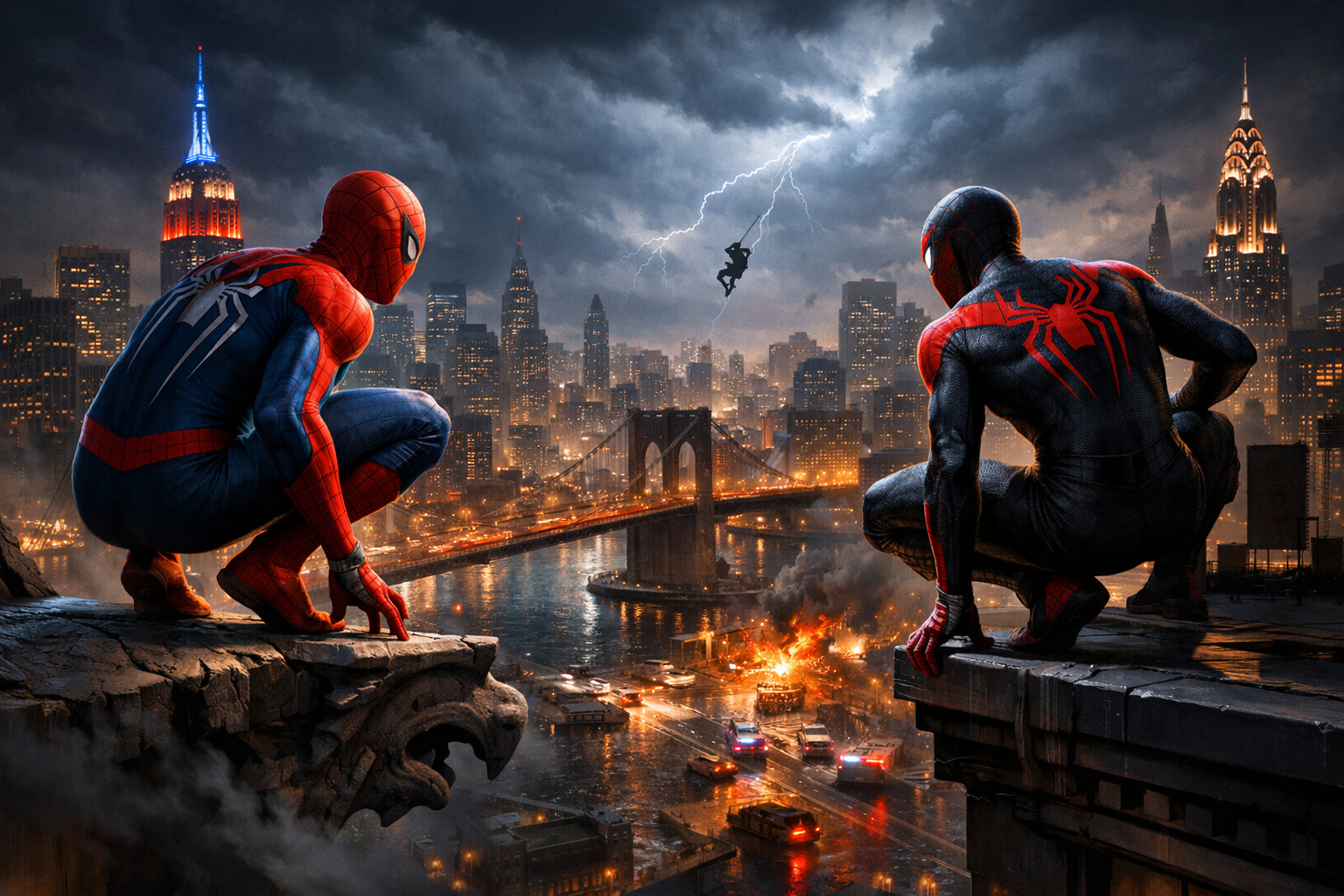
Marvel’s Spider-Man 2 brings two generations of Spider-Man into the same open-world adventure, giving Peter Parker and Miles Morales a shared city to protect and separate challenges to face. Developed by Insomniac Games, the sequel builds on the studio’s earlier Spider-Man titles with an expanded New York, faster traversal options and a story that puts both heroes under pressure.
Released for PlayStation 5 in October 2023 and later brought to PC in January 2025, the game is a single-player action adventure rather than a cooperative one. Players can control both Spider-Men, but the experience is structured around a campaign and activities designed for one person. Its distinctive premise lies in how it combines two playable heroes with a familiar superhero fantasy: moving through the city, responding to trouble and trying to balance extraordinary responsibilities with ordinary lives.
Two Spider-Men, one New York
Marvel’s Spider-Man 2 follows Marvel’s Spider-Man from 2018 and Marvel’s Spider-Man: Miles Morales from 2020. Those games established Insomniac’s versions of Peter and Miles, along with a New York populated by familiar Marvel characters and reimagined relationships. The sequel brings the two heroes together as co-protagonists, rather than treating Miles simply as Peter’s supporting character.
That distinction shapes the story. Peter is an experienced Spider-Man with a long history of trying to keep his responsibilities in balance. Miles is a younger hero, dealing with decisions about his future while continuing to grow into the role. Their shared work gives the game opportunities to explore both their partnership and the different ways they respond to the demands placed on them.
The central threat involves Kraven the Hunter and his arrival in New York in pursuit of formidable opponents. The story also introduces the symbiote, an alien organism associated with some of Spider-Man’s best-known comic-book stories. Its presence brings Venom into the narrative and raises questions about power, control and the effect of that power on the people closest to Peter.
Players who know the characters from comics or films will recognise elements of that setup, but this is Insomniac’s own continuity. Familiar names do not necessarily mean every relationship or event will unfold as it has in another adaptation.
Moving through an expanded city
New York remains the centre of the experience, but the playable map extends beyond Manhattan to include parts of Brooklyn and Queens. The expanded geography gives both heroes more neighbourhoods to cross and gives Miles, in particular, a stronger connection to the city beyond Manhattan’s skyscrapers.
Web-swinging is still the foundation of traversal. Players use momentum and web lines to travel between buildings, with the height and density of the surroundings affecting the route across the city. It is an important part of the game’s identity: movement is not just a way to reach the next objective, but a recurring expression of what makes playing as Spider-Man different from driving or running through an open world.
The sequel adds Web Wings, allowing Peter and Miles to glide as well as swing. Wind tunnels provide routes that can carry a hero across longer distances, while the ability to combine gliding with web-swinging gives players another way to move between districts and across water.
That addition also changes the rhythm of exploration. Swinging ties movement to nearby structures; gliding offers a different way to navigate open space. The expanded map makes that distinction useful, because the journey is no longer confined to the dense vertical environment most closely associated with Manhattan.
The city is not a full simulation of New York, however. It is an open-world interpretation built around superhero movement, story locations and activities. Its neighbourhoods provide context for those adventures rather than an exhaustive recreation of every street and building.
Combat built around speed and superpowers
Fights combine close-range attacks, aerial movement, webbing, gadgets and character-specific abilities. Both Spider-Men can use their agility to move around groups of enemies, dodge attacks and take the fight off the ground. The sequel also introduces a parry mechanic, giving players another response to attacks that call for a more direct defence.
Peter and Miles share the basics, but their powers give them different combat identities. Miles uses bioelectric abilities, building on powers established in his earlier game. Peter has access to mechanical Spider-Arms and, as the story develops, symbiote abilities. These options sit alongside more familiar punches, kicks and web attacks.
The distinction matters because switching heroes is more than a change of costume. Their abilities affect the tools available in a fight, even though both operate within the same broader action system. Players still need to manage positioning and incoming threats, but they can approach encounters with powers associated with the hero they are controlling.
Gadgets add another layer of choice. Rather than relying solely on individual punches or special abilities, players can use equipment to disrupt or control groups. Focus, meanwhile, can be used for healing or finishers, creating a choice between recovering health and removing an enemy from a fight.
Progression supports the dual-hero structure. Peter and Miles have their own skill trees as well as a shared skill tree, allowing players to develop abilities tied to each character and improvements relevant to both. The system reflects the game’s balance between treating them as distinct heroes and keeping them within a common set of rules.
How switching between Peter and Miles works
Outside certain story sequences and activities, players can switch between Peter and Miles while exploring the city. Some missions specify which Spider-Man must be used, so the choice is not unrestricted throughout the campaign. The story moves between their perspectives as events require.
This structure lets the game have it both ways: players get some freedom to choose a hero in the open world, while the campaign can focus on the character whose relationships or powers matter to a particular scene. It also reinforces the idea that the two are working in the same city, even when the player is controlling only one of them.
It is worth emphasising what that does not mean. Marvel’s Spider-Man 2 is not a two-player co-op game. Having two playable Spider-Men is a storytelling and gameplay feature within a single-player adventure, rather than an invitation for two people to explore New York together.
A superhero story beyond the main villains
Kraven and the symbiote provide the headline conflict, but the game also spends time on the lives surrounding Peter and Miles. Mary Jane Watson and Harry Osborn are important to Peter’s story, while Miles’s family and community remain central to his. Those relationships give the larger superhero threats a personal context.
The symbiote is particularly useful to that approach. It is not simply another piece of equipment: its role in the story is connected to changes in Peter and to how the people around him respond. For players familiar with the character, that premise draws on an established part of Spider-Man’s history. For newcomers, it offers a way into the tension between having more power and remaining in control of it.
Peter’s and Miles’s perspectives also let the sequel consider responsibility from different stages of life. Peter has years of experience but is still trying to manage competing obligations. Miles is navigating his own future as he becomes more confident in his role. The game’s interest in their personal lives helps distinguish its story from a straightforward sequence of battles against recognisable villains.
Some sequences also shift attention away from the two Spider-Men. Mary Jane is playable in parts of the campaign, continuing the series’ interest in showing events from a non-superpowered perspective. These sections offer a contrast to the mobility and abilities available when controlling Peter or Miles.
What there is to do outside the campaign
The open world contains activities beyond the main story, including requests connected to the Friendly Neighborhood Spider-Man app. These smaller encounters give the heroes reasons to engage with individual New Yorkers as well as large-scale threats.
Other optional activities are tied to particular characters and parts of the city. Peter can investigate science-related work through EMF experiments, while Miles has activities connected to Brooklyn Visions Academy. Mysteriums provide challenges associated with Mysterio. These are different kinds of diversion from the central campaign, rather than a single type of side objective repeated under one name.
That variety supports the game’s portrayal of Spider-Man as a neighbourhood hero. The main plot deals with dangerous villains and city-wide consequences, while smaller stories can focus on the people and places the heroes are trying to protect. Players interested primarily in the campaign can follow its central thread; those who want more time with the setting have additional activities to pursue.
Suits are another part of the experience, with costumes available for both Peter and Miles. They offer visual variety and draw on the wider history of Spider-Man designs. For readers coming to the game from other versions of the characters, the range of outfits is one of the more visible ways the sequel acknowledges that history while telling its own story.
Where the sequel fits in the series
Marvel’s Spider-Man 2 is a continuation rather than a clean break. It retains the open-world action structure, acrobatic combat and cinematic storytelling associated with Insomniac’s earlier games, then expands them around two protagonists. The additions are most significant where they change the shape of the experience: a larger city to cross, gliding alongside swinging, and a campaign divided between Peter and Miles.
That also means familiarity with the earlier games can add context. Relationships and past events matter, particularly for Peter, Miles and the people close to them. The sequel presents its own central conflict, but players beginning here will be entering an existing continuity rather than an origin story for either hero.
For someone deciding whether the game matches their interests, the clearest expectation is a story-led superhero adventure with open-world activities—not a multiplayer game or a role-playing game built around creating a character. Its progression offers ways to develop established heroes, while the campaign follows a defined narrative.
The sequel’s defining idea is the partnership at its centre. Peter and Miles share a city and many of the same responsibilities, but their powers, relationships and personal pressures give the game two perspectives on being Spider-Man. Together with the expanded traversal and symbiote storyline, that makes Marvel’s Spider-Man 2 a distinct chapter in Insomniac’s series rather than simply another visit to the same New York.
Leave a Reply